Wednesday, April 17, 2019

CHOOSING THE RIGHT TYPE OF FILL MATERIAL


Understanding the different types of fill materials and their uses will help you choose the right brush for any application. There are many different bristle materials out there to create the perfect industrial brush. Because it’s important to understand the brush fill characteristics for your specific application, our experts can help guide you through this selection process.

To start, there are three main bristle material categories the industrial cleaning world uses: synthetic, natural and wire. Let’s take a closer look into what benefits, characteristics and attributes each of these categories provide users.
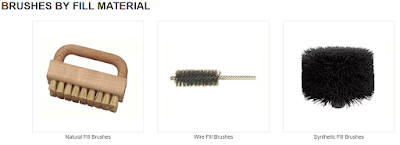

Synthetic Fill Material –
CHARACTERISTICS: Easy to clean and does not scratch fragile surfaces while still providing excellent bend recovery, abrasion, chemical resistance, and overall break strength.
USES: Applications include general purpose cleaning, buffing, dusting, and wet scrubbing.

Natural Fill Material
CHARACTERISTICS: Ideal for sweeping light-weight particles or removing dust while still having excellent bend recovery and break strength.
USES: Applications include general purpose cleaning, buffing, dusting, and wet scrubbing.

Wire Fill Material
CHARACTERISTICS: Excellent abrasion and wear resistance attributes with an equally good bend recovery.
USES: Applications can include heavy-duty cleaning, deburring (like rust removal or burnishing), and delicate finishing or polishing projects as well.

               When deciding on which industrial brush suits your application best, remember the basic thee bristle categories and you should be in good shape. When ordering from Gordon Brush®, rest assured, you're buying a premium quality line of American made brushes.

Gordon Brush® manufacturers over 17,000 different kinds of brushes for every industry imaginable. With over 3,500 brushes available for same day shipment, Gordon Brush® has the right brush for your specific need. If a brush exists, we have it…if it doesn't, we'll make it!

Gordon Brush® has a team of brush experts that can help you select the best brush for your specific application or work with you to design the perfect custom brush.

Friday, April 12, 2019

Choosing the Correct Roller Cover for Your Job


When selecting a rollercover, the two most important factors to consider are: the paint sheen and the nap height.
Paint Sheen:
The sheen is the glossiness of a paint finish.

Gloss or Semi-Gloss Paint
Glossy paints have a very high sheen and will tend to show more lint on the roller surface. Therefore, when using a gloss or semi-gloss paint, choose a shed-resistant woven cover. The fibers that make up the woven fabric are locked into the backing with a tight, "double lock" process providing a smooth and virtually lint-free finish.

Flat, Eggshell, Or Satin Paint
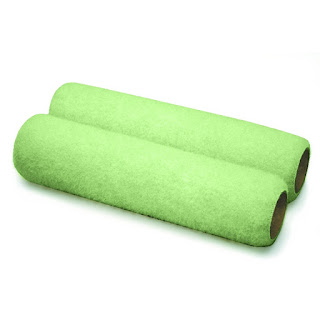
Gordon Brush Twin Pack Roller Cover R29301
A knit roller cover is recommended when applying flat, eggshell, or satin paints and stains. Knit roller covers can pick up and release higher amounts of paint than woven fabrics because the fibers have a looped backing with a single pass-through process resulting in a more "open" fabric. However, if you’re looking for a finer, professional-quality finish, a shed-resistant woven roller cover is also recommended with flat or satin paint.

Microfiber and foam roller covers can also be used. You can achieve spray-like results with both of these roller covers when applying any type of paint, varnish, or enamel. They are great to use on cabinets, doors, and other smooth surfaces.

Nap Height:
Nap height is the length of the fibers that extend from the backing and carry the paint to the wall.

For smooth surfaces, choose a shorter nap (3/16" or 1/4") to apply the paint evenly. Because a shorter nap picks up less paint, it is common for some painters to "bump up" to a longer nap for increased production. While this can be a good idea to speed-up your painting project, it is important to note that higher naps may leave a textured look on a smooth surface. Always remember to select a nap height that will provide you with your desired finish regardless of the paint pick up and release capabilities.

Rough Surfaces
Rough surfaces require a higher nap (3/4" to 1-1/2") so the long fibers can reach into the valleys of the texture. Higher nap heights are great for textured plaster or stucco, siding, decks, concrete block, brick, and corrugated metal. Long nap heights offer great paint pick up and release, which makes getting into all the cracks and crevices of the surface easy. Remember, the rougher the surface, the higher the nap to make your job easier.

Friday, March 15, 2019

GORDON BRUSH MFG. CO. ACQUIRES SPECTRUM PAINT APPLICATOR CORP.

Date: 2019-03-15

CITY OF INDUSTRY, CA -- Gordon Brush Mfg. Co., Inc. has acquired the assets of Kirschner Brush Mfg. Company, located in Bronx, New York.

CITY OF INDUSTRY, CA -- Gordon Brush Mfg. Co., Inc. has acquired Spectrum Paint Applicator Corp., located in Newark, New Jersey. The Company's manufacturing and operations will be relocated and incorporated into Gordon Brush's 183,000 sq. ft., City of Industry, CA manufacturing facility.

Since 1945, Spectrum Brush has manufactured industrial and consumer paint brushes, paint rollers and artist brushes. Arthur Edelson, Spectrum's CEO, explains, "It’s time for us to step aside so that the Company can continue to grow. We felt that Gordon Brush® was the best fit to take Spectrum Brush to the next level, to continue our family tradition of individualized customer service, and to best manufacture our line of American made consumer, professional, and industrial paint applicators."

Ken Rakusin, President and CEO of Gordon Brush notes, "The acquisition of Spectrum Brush, our twelfth acquisition, consolidates Gordon Brush's reach in the paint brush category. Spectrum Brush will add to our stable of other acquired paint and artist brush companies. These include: Redtree Industries and Kirschner Brush in the paint brush and roller sector and Marx Brush in the artist brush sector. The Spectrum Brush acquisition dramatically enhances our scale, product offerings, and geographic reach — creating new synergies that better position us for future growth and investment in new and existing markets."

"It's another perfect fit for Gordon Brush® that ties into its mantra of being, Proud To Be An American Manufacturer™. This acquisition enhances the global product offering of Gordon Brush's line of paint and artist brushes and opens up new avenues for the manufacture of custom paint and artist brush products. As the demand for American made products increases, we are proud to be at the forefront of that movement."

Wednesday, January 30, 2019

Gordon Brush Mfg. Co. featured in Paint & Decorating Retailer Magazine

California-based Gordon Brush Mfg. Co. Inc. has acquired Parker Brush Inc. Parker Brush’s manufacturing and operations will be relocated and folded into Gordon Brush’s 183,000-square-foot manufacturing facility, which is located in City of Industry, California.

Since 1959, Parker Brush has manufactured stock and custom brushes for the agriculture, food processing and electronics industries.

“We felt that Gordon Brush was the best fit to take Parker Brush to the next level, to continue our family tradition of individualized customer service, and to best manufacture our line of American-made brushes,” says founder and former CEO of Parker Brush Melody Orenchuk.

Ken Rakusin, president and CEO of Gordon Brush, says the acquisition will allow the company to reach new heights.

“The Parker Brush acquisition dramatically enhances our scale, product offerings and geographic reach— creating new synergies that better position us for future growth and investment in new and existing markets,” he says.

Established in 1951, Gordon Brush currently fabricates more than 2,000 types of brushes, including brass, nylon and natural-bristle brushes.


Thursday, December 20, 2018

Milwaukee Dustless Brush worked with Dairy Queen® to create an 8 foot long metal-free brush that could clean hard-to-reach areas on the inside of Dairy Queen’s® ice cream machines’ dispensing heads.

To clean the ice cream machines, the custom-made brush was snaked up into the orifice of the dispensing head and shimmied around to remove any build-up. It was important that the brush meet the strict FDA hygienic standards for food preparation and consumer safety. Our design team at Milwaukee Dustless Brush chose metal-free bristles since they alleviated the risk posed by any wire bristle-breakage in the machines. In addition, the metal-free bristles did not damage the surface of the ice cream dispensing heads, helping to maintain the finish and prolong the longevity of the Dairy Queen® ice cream machines.

Friday, December 14, 2018